Spetses · 10–14 May 2027

Recovering Our World.

From the Inside Out

We cannot heal from the same realm in which the wounds occurred. This year, the circle turns toward solutions and the way forward — away from the diagnosis of what ails us and toward what might yet be possible. Together we will activate the field with potential, compassion, and beauty, working across the many levels we are made of: body and nervous system, heart and relationship, mind and meaning, and the wider world we share. The depth of the experience will be more refined than Spetses 2026 — an invitation to recover not only ourselves, but our world.

Confirmed Guests

The first voices are confirmed for 2027, including two returning from our inaugural gathering. The container continues to grow, and more faculty will be named here as they confirm.

Psychiatrist · Researcher · Founder, Onaya Science
Clinical Psychologist · Researcher · Founder, ACER Integration
Neuroscientist · Researcher · Co-Director, UCL Centre for Consciousness Research
Psychologist · Zen Monk · Author
Founder, The Relational Estate Advisory · Co-founder, Death Over Dinner
One Sanctum Founder
Dr Wade Davis

Dr Wade Davis

Explorer · Anthropologist · Author

Named by the National Geographic Society as one of the Explorers for the Millennium, Wade Davis has been described as “a rare combination of scientist, scholar, poet and passionate defender of all of life’s diversity.” As a botanical explorer, and later Explorer-in-Residence at the National Geographic Society (2000–2013) and Professor of Anthropology at the University of British Columbia (2014–2024) his work has taken him from the Amazon to Tibet, Africa to Australia, Polynesia to the Arctic. His 24 books, published in 26 languages, include the international best sellers The Serpent and the Rainbow, One River, The Wayfinders, Magdalena and Into the Silence, winner of the 2012 Samuel Johnson prize, the top nonfiction prize in the English language. National Geographic Books has published two collections of his photographs, Light at the Edge of the World and Wade Davis: Photographs. His 40 film credits include Light at the Edge of the World, an 8-hour documentary series written and produced for the National Geographic, and Sendero de la Anaconda, the most watched documentary in the history of Colombian cinema. One of 20 Honorary Members of the Explorers Club, Davis is Honorary Vice-President of the Royal Canadian Geographical Society, and recipient of 12 honorary degrees, as well as the 2009 Gold Medal from the Royal Canadian Geographical Society, the 2011 Explorers Medal, the 2012 David Fairchild Medal for botanical exploration, the 2015 Centennial Medal of Harvard University, the 2017 Roy Chapman Andrews Society’s Distinguished Explorer Award, the 2017 Sir Christopher Ondaatje Medal for Exploration, and the 2018 Mungo Park Medal from the Royal Scottish Geographical Society. In 2016, he was made a Member of the Order of Canada. In 2018 he became an Honorary Citizen of Colombia. When not traveling, Davis divides his time between his home on Bowen Island, and a remote fishing lodge in Tahltan territory in northern British Columbia.

Dr Bayo Akomolafe

Dr Bayo Akomolafe

Philosopher · Psychologist · Founder, The Emergence Network

Philosopher, psychologist, poet and essayist, born in western Nigeria to Yoruba parents, whose work invites us to slow down and meet the crises of our times differently. He is the founder of The Emergence Network and the originator of postactivism, a call to look beyond familiar strategies of change and attend to the cracks where something new might emerge. He teaches at Pacifica Graduate Institute, has been an associate adjunct professor at the University of Vermont and a visiting professor at Middlebury College, and serves on the board of Science and Non-Duality. He is the author of These Wilds Beyond Our Fences: Letters to My Daughter on Humanity’s Search for Home, and co-author, with Molefi Kete Asante and Augustine Nwoye, of We Will Tell Our Own Story. In 2021 he received the New Thought Walden Award. He lives between India and the United States.

Dr Simon Ruffell

Dr Simon Ruffell

Psychiatrist · Researcher · Founder, Onaya Science

Trained across three modalities: Western medicine as a doctor specializing in psychiatry, research psychology with a PhD in Amazonian ayahuasca and mental health, and traditional plant medicine as a student of Shipibo curanderismo. Founder and Executive Director of Onaya Science, a nonprofit researching ayahuasca in naturalistic Amazonian settings alongside education rooted in Indigenous knowledge. Lecturer in Psychology and Psychedelics at the University of Exeter and Executive Director of the Center for MINDS. His work centres on understanding plant medicines from both Indigenous and Western perspectives, supporting a more integrative and relational approach to healing.

Dr Rosalind Watts

Dr Rosalind Watts

Clinical Psychologist · Researcher · Founder, ACER Integration

Clinical psychologist, mother, and nature lover. Her work as Clinical Lead for Imperial College London’s psilocybin trial has made her one of the most prominent voices and minds in the field of psychedelic research. She has been named one of the 50 Most Influential People in Psychedelics, and one of the Top 16 Women Shaping the Future of Psychedelics. What sets her apart is her focus on integration, harm reduction and inclusion in the psychedelic space. She builds tools and structures to foster connectedness after psychedelic experiences, finding the inspiration for their design in nature. Through all of her work, her main learning has been that safe and effective use of psychedelics requires substantial integration support. She co-founded the UK’s first psychedelic integration group, and in 2022 launched ACER Integration, standing for Accept, Connect, Embody, Restore, a global online community whose participants follow a thirteen-month process together, connecting more deeply to the self, to others, and to nature.

Dr Christopher Timmermann

Dr Christopher Timmermann

Neuroscientist · Researcher · Co-Director, UCL Centre for Consciousness Research

Dr Chris Timmermann is Co-Director of the UCL Centre for Consciousness Research, where he studies some of the deepest questions about the human mind: the nature of consciousness and the self, how our experience of reality is constructed, and whether altered states can contribute to human flourishing. A leading researcher at the intersection of neuroscience, psychedelics, and contemplative practice, Chris pioneered some of the first investigations into how DMT and 5-MeO-DMT affect the human brain and consciousness. He led the DMT Research Group at Imperial College London and has studied experiences ranging from ego dissolution and mystical states to the striking parallels between psychedelic and near-death experiences. His current work brings psychedelic science into dialogue with meditation and contemplative traditions, including research comparing 5-MeO-DMT with advanced meditation as radically different pathways into altered states of consciousness. Across his work, Chris explores a question that sits at the frontier of both science and spirituality: what can extraordinary states of consciousness teach us about the mind, the nature of the self, and our capacity for connection, meaning, and human flourishing.

Dr Michael Ryoshin Sapiro

Dr Michael Ryoshin Sapiro

Psychologist · Zen Monk · Author

A clinical psychologist, ordained Zen Buddhist monk and poet, whose work sits where contemplative practice meets the science of transformation. He teaches internationally on expanded human capability, psychedelic psychotherapy, and what he calls futuremaking. He is a Fellow at the Institute of Noetic Sciences and teaches on the Psychedelics Today certification programme. His research collaborations, with Dan Siegel and Cassandra Vieten among others, look at interconnectedness, compassion, belonging and well-being. In his clinical practice he offers ketamine assisted psychotherapy to first responders, to special operations combat veterans, and to people from his own community, work that keeps the theory honest. His book Truth Medicine, on healing and living authentically through psychedelic psychotherapy, was published by Hachette Go in 2025. He describes his purpose plainly, as personal awakening for the sake of collective transformation. Returns from Spetses 2026.

Angel Grant

Angel Grant

Founder, The Relational Estate Advisory · Co-founder, Death Over Dinner

Angel Grant is founder of The Relational Estate Advisory, a practice focused on supporting the emotional and relational challenges of loss and legacy. She is cofounder of Death Over Dinner and Drugs Over Dinner, global movements that have inspired more than 200,000 dinners across 30 countries. Her work brings people into honest conversations about death, addiction, the healing potential of entheogens, and the relationships that shape our lives, including the one with ourselves.

A writer and meditation teacher focused for nearly three decades on consciousness, Angel explores how fear can be part of an inheritance that shapes what we believe, how we relate, and what we permit ourselves to want and create. Her work examines the cost of belonging when it requires us to abandon ourselves, and how we recover agency without sacrificing connection. Since 2010, she has trained teachers and facilitators in meditation, yoga, somatic awareness, and emotional intelligence. She has worked alongside her longtime mentor, Dr Gabor Maté, in trauma-healing retreats and has developed programs for adolescent treatment, wilderness therapy, and under-resourced schools and communities.

Her teaching and speaking highlights include the U.S. Surgeon General's Facing Addiction in America Summit, the Dalai Lama's 80th birthday gathering with Peak Mind Foundation, Kripalu, Summit Series, Science and Nonduality, The Shift Network's Psychedelic Healing Summit, and the New York Academy of Medicine with Lab/Shul. Across private work, retreats, and public dialogue, she invites people to face difficult truths, have the conversations that matter, and discern their own voice from inherited fear and the expectations of others, to live interdependently. She lives in Charleston, SC with her son, Sebastian, and their spaniel, Jasper.

Lara Tambacopoulou

Lara Tambacopoulou

One Sanctum Founder

Founder of One Sanctum and curator of its gatherings. A systemic and transgenerational psychotherapist, Family Constellations facilitator and psychedelic-assisted therapist, Lara weaves the personal, the ancestral and the collective into a single field of healing. A lifelong seeker of solace in a world marked by conflict, trauma and social unrest, she has come to understand that the only true antidote lies in remembering what happens when we loosen our grip on the self and surrender into the sea of an ever-evolving field of multi-relationality.

Why We Gather

Personal trauma, ancestral severance, and the unravelling of the living world are not three problems but one phenomenon seen at three scales: the way a child disconnects from a parent is not different in kind from the way a lineage forgets its dead, or a people forgets its land. If belonging and rupture share a single grammar across body, family, and ecology, then recovery cannot be a clinical category alone — it must happen at every scale or not at all. Recovering Our World from the Inside Out is built on the wager that these can be met together, in the same room, the same body, the same five days. Shaped by all we learned at our founding gathering, this is an immersive retreat rather than a conference: the true work lives not in the talks but in the spaces between them — the morning circle, the dusk ritual, the long walk, the held silence — with a faculty who live in the retreat alongside us, present for the duration of their contribution.

What This Year Is

We prepare the ground.

This year we continue from our time with Dr. Gabor Maté and we are reaching for more. Recovering Our World is the first of an annual gathering.

It is doing something slower and, we think, more useful: gathering a group of people who can stand in front of what is actually happening, with clarity, without flinching, and in right relationship with it. The solving comes after. It has to.

Each year that follows will go further into the terrain we map here.

How It Happens

People do not change their minds by being better informed, although this may happen if they have been prepared.

Mostly, this takes place by creating the right conditions, by moving the senses of a person until they merge with the others in the room, and with the nature that holds all of us. Through art, music, ritual and movement. Through gathering. The thinking follows after.
Mornings
A few hours of conversation. Faculty and participants in the same room, thinking together rather than being presented to.
Afternoons
Small groups. This is where most of the week actually happens.
Evenings · Six until ten
The open-air stone amphitheatre at the Anargyrios school, under the sky. Each night is an experience rather than a talk, music, ritual, film, breath, story.
The Place
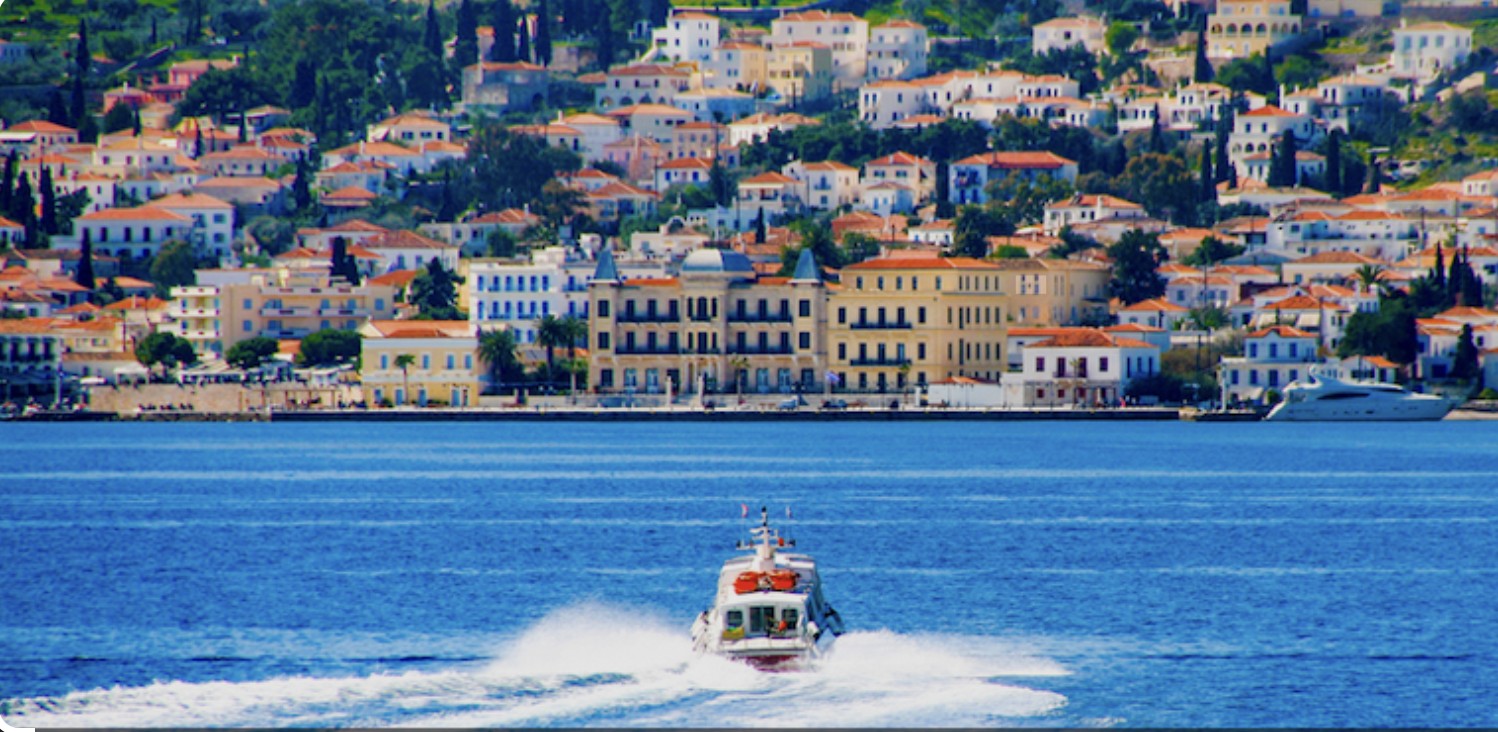
Spetses waterfront at the Poseidonion, with a boat on blue water

Spetses.

A small island in the Saronic Gulf where cars are largely absent and the pine comes down to the sea. The Poseidonion hotel, a magnificent 1914 building standing by the water, is our home for five days.

A short walk away is the amphitheatre of the Anargyrios and Korgialenios School: open stone tiers, nestled inside the pine forest.

Ways to Join

Choose your place.

All prices per person, VAT included. Concession places are available.

Reserve
Who Comes

We come together to stay together.

We are not a wellness retreat. We are guided by the urgency of our time.

This is for people who have tried the solutions and know something else is being asked of them, and for people whose decisions reach further than their own lives. We do not think that is a reason to leave anyone alone with what they are part of.